How Long Does It Take for Your Brand to Appear in an AI Response?
GEO doesn’t work like flipping a switch on an ad. Understand why an AI's response varies between executions and how MencionAI monitors this process regularly until it becomes a confirmed pattern.
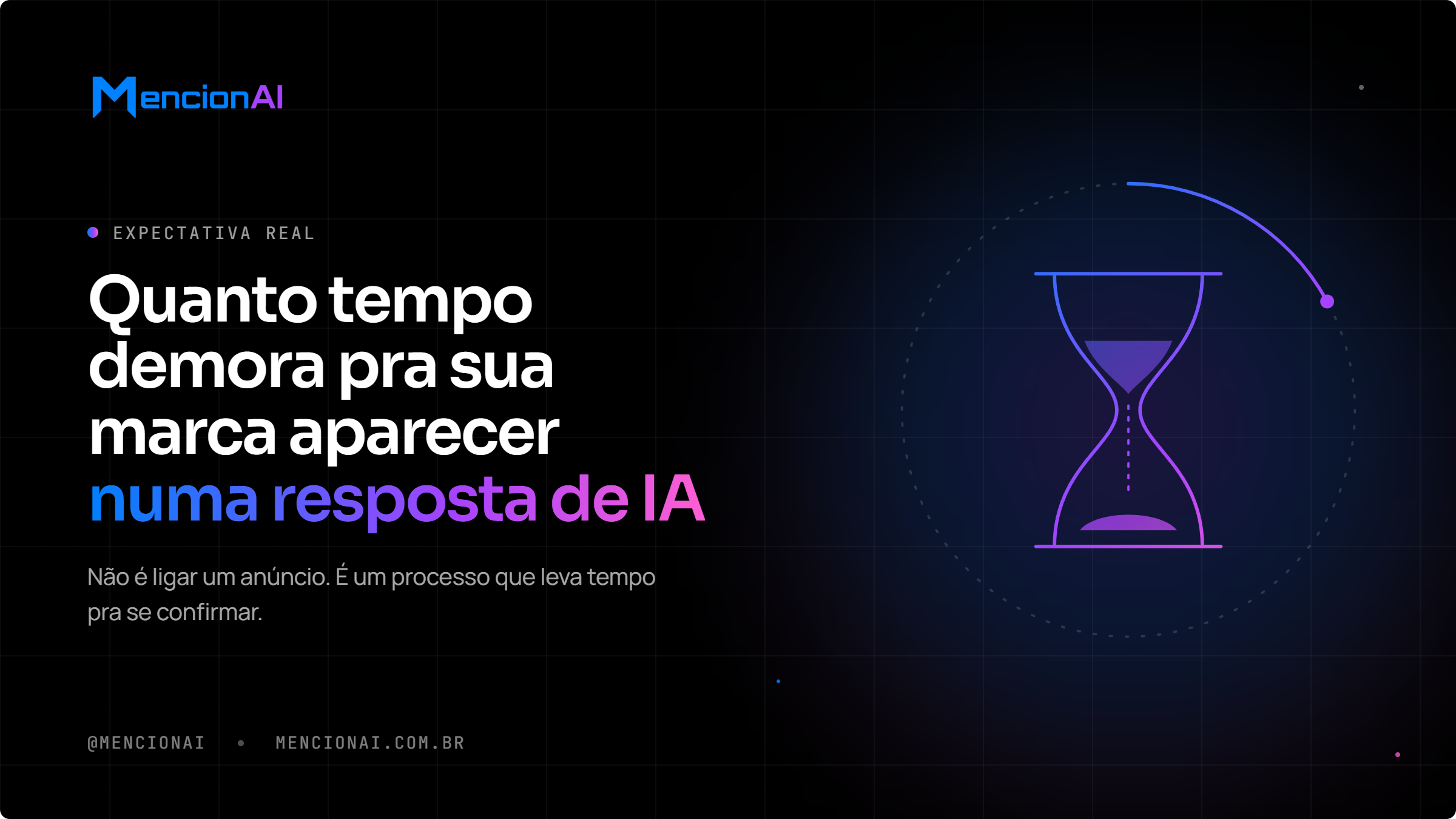
GEO doesn’t work like flipping a switch on an ad. There isn’t a button that turns on brand visibility in an AI response and shows effects in the next query. It’s a process that takes time to confirm, and understanding this helps avoid two common pitfalls: giving up too soon and relying on a single check.
Why It’s Not Instantaneous
ChatGPT searches the web when the question asks for current information, and OpenAI itself warns about the limits of this. In the official help center, the company states that "search results and citations may be incomplete, outdated, or incorrect" (OpenAI Help Center).
Adding to this is another factor: the response from an AI model is not entirely deterministic. Even using parameters designed to reduce variation between calls, OpenAI’s own documentation acknowledges that internal adjustments in the system can affect the reproducibility of responses (OpenAI API, Advanced usage). In practice, this means that the same question can generate different answers from one execution to another, even without any change on the brand's website. Publishing a new page or correcting a data structure doesn’t show up in the next response; the effect takes time to confirm.
Why a Single Check Isn’t Enough
A study by SparkToro in partnership with Gumshoe.ai had 600 volunteers run 12 prompts across different AIs, totaling 2,961 executions. The result found: less than 1 in 100 chance that two responses would bring exactly the same list of brands (SparkToro).
If a single response varies so much, testing a prompt just once and drawing conclusions about brand visibility doesn’t hold up. What shows a real trend is repeating the same prompt over weeks and looking at how often the brand appears, not a single response.
Confirmed Results, Not Just Appearances
Changing content, correcting data structure, or reinforcing a source marks the beginning of the work. The effect only becomes visible when the same prompt is tested again, multiple times, over weeks, showing whether it has become a real trend or was just an isolated response.
This is exactly why MencionAI monitors prompts regularly, across multiple AI models at the same time, tracking the frequency of the brand's appearance over time, rather than relying on a one-time check that is already outdated. Regular monitoring replaces the certainty of a switched-on ad with the evidence of a confirmed pattern.
If you want to truly track this for your brand, just schedule a demo.
Pedro, CMO of MencionAI
Frequently Asked Questions
Why doesn’t my brand appear in an AI response right after I changed something on the website? Because the search that feeds the response may bring incomplete or outdated results, according to OpenAI itself, and the model's response is not entirely deterministic. Even without any change on the site, two executions of the same prompt can yield different results.
What did the SparkToro and Gumshoe.ai study show about this? With 600 volunteers running 12 prompts across different AIs, totaling 2,961 executions, the study found less than 1 in 100 chance that two responses would bring exactly the same list of brands.
Is testing a prompt just once enough to know if my brand appears in an AI? No. A single response does not show a trend, only a snapshot that can change in the next execution. What indicates a real pattern is repeating the same prompt over weeks and tracking the frequency.
How long does it take to see results from a GEO action? There isn’t a fixed number, as it depends on how often the models reprocess the content and the competition for that prompt. What can be said is that the effect doesn’t appear all at once; it confirms over weeks of repeated monitoring of the same prompt.
Don't stay invisible to the future — be seen today
Monitor how your brand shows up in ChatGPT, Claude, and Gemini. Start tracking AI citations and improve your generative visibility.