The AI Described Your Company Wrong. What Now?
When AI describes your company incorrectly, focus on people-first content and use MencionAI to monitor citations in ChatGPT, Gemini, and Claude.
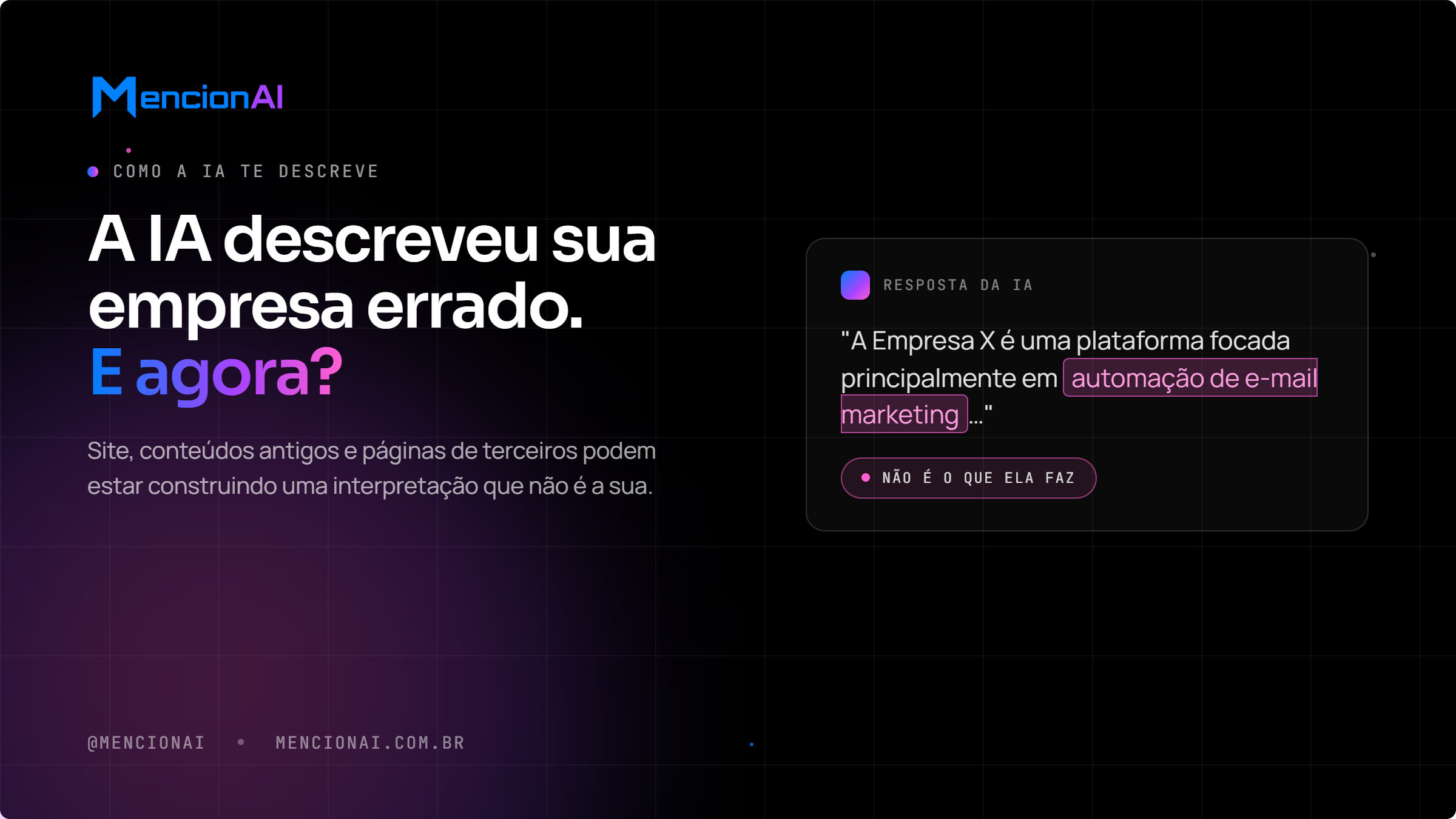
When an AI describes your company incorrectly, the first reaction is often: we need to create content to fix this.
It might be.
But before that, there's a more important question: where did the AI get this information?
The AI Described Your Company Wrong. What Now?
Imagine someone asks ChatGPT, Gemini, or another AI what your company does.
Your brand appears in the response, but it’s presented as a solution for a different market. A product that you don’t even offer gets highlighted. A competitor appears as more complete. Or an outdated description of the company continues to be used.
You got a mention, but it’s not necessarily helping.
That’s why looking only at the quantity of citations tells just part of the story.
The First Step is Understanding the Error
Before rushing to change the website or publishing ten new articles, it’s worth investigating what’s happening.
In which prompts does the incorrect description appear? Is the problem happening in a specific AI or in several? What sources appear in these responses? Are your competitors being described correctly? Is there any page of yours or third parties reinforcing that information?
This diagnosis significantly changes the action plan.
If an old page from your own company is causing confusion, the action might be to update that information.
If external sites continue to associate your brand with an old positioning, producing five more blog articles may not address the problem.
If the AI understands your product but doesn’t find enough evidence to categorize or compare it, then there may indeed be a content gap.
Action comes after understanding the cause.
Content Comes in When There’s a Content Gap
Creating content remains an important part of GEO, but the question should be what content is missing?
It could be a case study showing that your solution serves a specific segment.
It could be a clearer product page.
It could be a comparison that helps explain where your solution fits.
It could be documentation, an integration page, proprietary data, FAQs, or simply a more consistent description of the company on important pages.
The idea is not to publish for the sake of publishing.
It’s to leave better evidence about who your company is, what it does, for whom it makes sense, and why someone should consider it.
This is Where Monitoring Starts to Make a Difference
An isolated wrong answer says little.
When you track the same themes, prompts, and competitors over time, you start to find patterns.
At MencionAI, we monitor how brands appear in different AI models and use these responses to understand frequency, position, sentiment, competitors, sources, and other signals related to visibility.
From this, the goal is to turn the diagnosis into an action plan.
Because knowing that your company appeared incorrectly is interesting.
Understanding why this happened and what to do to change it is where the real work begins.
How to Investigate an Incorrect Description
If you found an incorrect response about your company, start by recording the exact prompt and the response.
Then, test close variations of the same intent and compare the results across different models.
Observe which competitors appear, how they are described, and, when sources are available, which pages are supporting that response.
Only after that is it worth deciding whether the correction involves your website, new content, updating existing pages, strengthening external evidence, or another action.
This process avoids a common problem in GEO: trying to fix everything with more content without knowing exactly what is causing the low visibility or the misinterpretation.
GEO is Also About Being Understood Correctly
Appearing in an AI response is an important metric.
But appearing doesn’t necessarily mean being recommended, and being cited doesn’t mean the AI understood your company the way you would like.
That’s why our view of GEO goes beyond counting mentions.
We want to understand when the brand appears, how it appears, alongside whom, supported by what information, and what can be done to improve this scenario.
It’s this logic that we use to transform monitoring into action within MencionAI.
Frequently Asked Questions
My company appeared on ChatGPT with incorrect information. What should I do? First, try to identify if the error repeats in other prompts and models. Then, analyze the sources and information available about your company before deciding what action to take.
Does creating more content solve it? It depends on the cause. If there is a clear information gap, content can help. If the problem lies in old pages, conflicting information, or external sources, simply increasing the volume of publications may not resolve it.
Do I need to monitor only ChatGPT? No. The way a brand appears can change between ChatGPT, Gemini, Claude, Perplexity, Grok, DeepSeek, and other models. Comparing these responses helps identify if there is a pattern or a specific problem in a given environment.
Does GEO replace SEO? No. SEO remains an important foundation for discovery and understanding of content on the web. GEO adds another layer: understanding and improving how brands, products, and information appear within AI-generated responses.
Don't stay invisible to the future — be seen today
Monitor how your brand shows up in ChatGPT, Claude, and Gemini. Start tracking AI citations and improve your generative visibility.