Content Volume Doesn't Solve GEO: Build Evidence for AI to Recommend Your Brand
Content volume alone is not enough for GEO. Learn how to build evidence that helps ChatGPT, Gemini, and Claude accurately recommend your company.
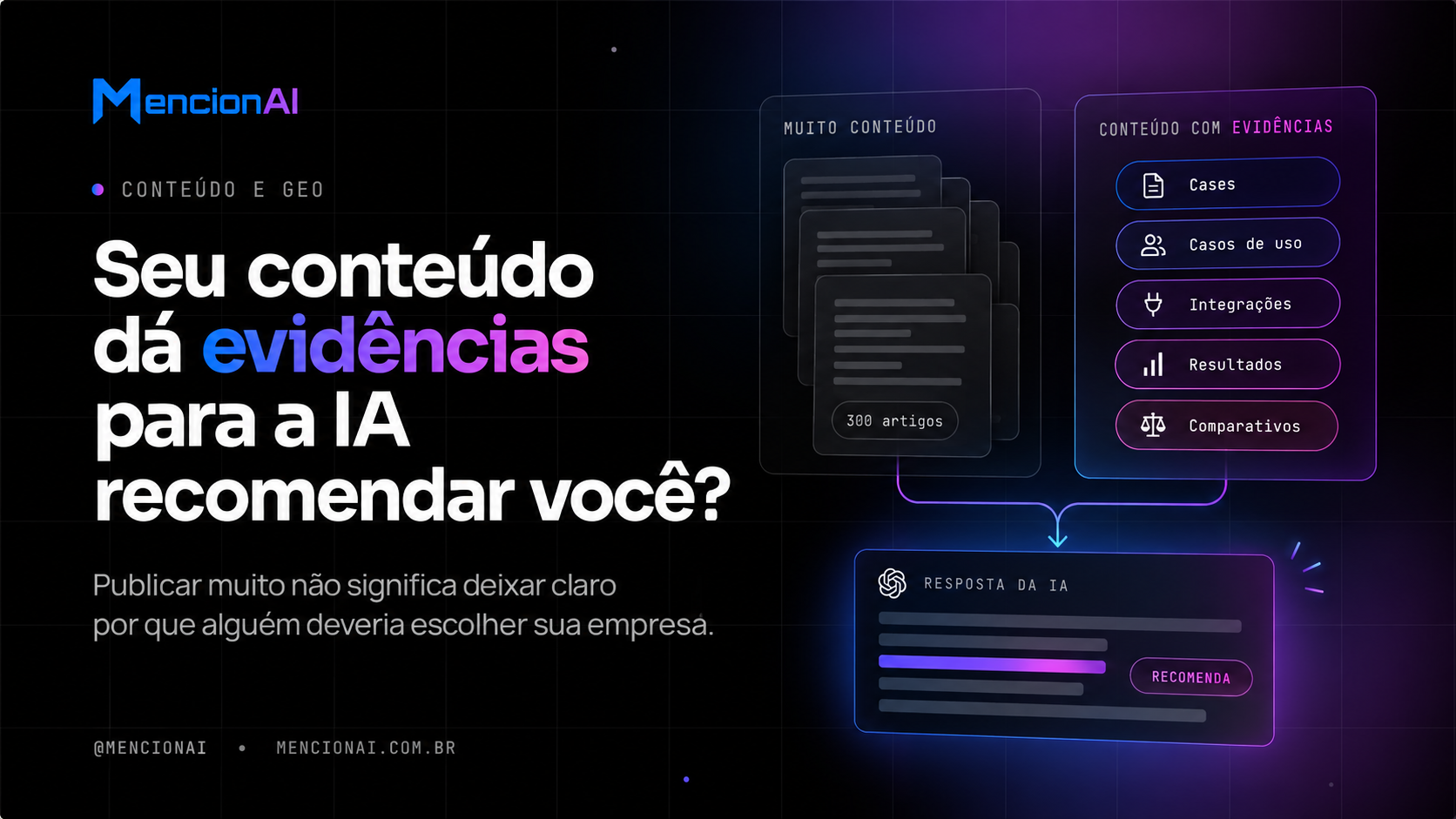
Having a lot of published content doesn’t necessarily mean providing enough information for an AI to recommend your company.
I’ve been thinking a lot about this while looking at companies that offer very similar solutions. Sometimes one has a huge blog, publishes every week, and explains the market very well. Another has less content, but you find detailed case studies, use case pages, comparisons, integrations, reviews, documentation, and other sources talking about it.
When someone asks an AI which company it recommends to solve a specific problem, these two brands don’t arrive at the answer with the same amount and quality of information available.
And that’s where content and GEO start to get more interesting.
Producing More Doesn’t Mean Explaining Better
I don’t think the conclusion is that content has ceased to be important. Quite the opposite.
A good case can make it extremely clear to an AI that a particular solution works for a type of company, within a specific scenario, and has already generated certain results.
The problem is thinking that increasing volume solves everything.
Publishing 40 generic articles about market trends may add much less information about your company than a single case showing who used your product, what problem needed solving, how they used the solution, and what the result was.
The question shifts from just "how much are we publishing?" to "what can an AI understand about us from what we are publishing?".
The Format Also Affects How Much Information Is Available
Another thing I’ve observed is that sometimes the company already has the information it needs. It’s just in the wrong place or in a poorly utilized format.
The sales team has presentations full of real cases. The CS team knows dozens of situations where clients use the product. Comparisons come up in calls every day. There are interesting results published only in a LinkedIn post or hidden within a PDF.
All of this is knowledge about the company, but it’s not always organized in an easily findable, accessible, and relatable way.
That’s why sometimes the opportunity isn’t in creating something new from scratch. It’s in transforming something that already exists into a case page, a use case page, a FAQ, documentation, a comparison, or another format that makes that information clearer and more accessible.
The Less the AI Needs to Infer, the Better
"We are a complete platform."
"We are a market reference."
"We offer an innovative solution."
These phrases may make sense in institutional communication, but they say very little to an AI trying to figure out which solution to recommend for a specific question.
Now compare this with a company that shows which segments it serves, which problems it solves, with which tools it integrates, how clients use the product, and what results it has already generated.
There’s much less for the AI to interpret.
The AI can relate a specific question to specific information about that solution.
That’s why I’ve been looking less at content merely as volume and more at the number of questions about a company that we can answer with available evidence.
Not All Evidence Needs to Come from the Company Itself
This may be one of the most important points.
You can write on your own site that you have the best product on the market. It’s very different from having clients talking about it, reviews, comparisons, articles, communities, partners, and other independent sources corroborating parts of that story.
That’s why GEO doesn’t end at the blog.
The website is part of the information available about a brand. What exists outside of it also helps AIs build a perception of who that company is, what it does, and in which contexts it makes sense to mention or recommend it.
The more consistent this information is across different sources, the less the AI needs to fill in the gaps on its own.
How MencionAI Fits In
It’s precisely this gap between what a company really is and what AIs can understand about it that we try to find at MencionAI.
Sometimes the gap is in the content. In other cases, it’s in the absence of certain evidence, in the sources used by AIs, in the way the company is being described, or even in a technical issue preventing certain information from being accessed.
That’s why the goal of a diagnosis shouldn’t simply be to end up with a list of articles to produce.
The idea is to understand why a brand appears, doesn’t appear, or loses a recommendation to another company and to transform those gaps into actions that make sense for that case.
Because you can have an excellent product and very satisfied customers.
If almost no evidence of this is available outside your team’s conversations, it’s hard to expect an AI to simply know.
Pedro, CMO of MencionAI
Frequently Asked Questions
Does GEO replace SEO? No. SEO ranks links on the SERP. GEO measures if your brand is mentioned in the responses of ChatGPT, Gemini, Claude, Perplexity, Grok, and DeepSeek.
What should I publish first to be cited by AIs? Comparative pages, FAQs with stable anchors, llms.txt, and schema of Organization — then re-scan the same prompts.
What is E-E-A-T and how does it help AI citations? Google Search Central describes E-E-A-T as experience, expertise, authority, and trust — trust first. Named authors, firsthand experience, and citations to official docs help judge who signs the page. Structured data is not required for AI Overviews, but Article, Person, and Organization still help Search understand author and publisher.
Don't stay invisible to the future — be seen today
Monitor how your brand shows up in ChatGPT, Claude, and Gemini. Start tracking AI citations and improve your generative visibility.