51% of B2B Buyers Prefer AI Over Google: How to Adapt
MencionAI Blog Pedro Vianna Quintian
MencionAI Blog Sep 04, 2026 · 4 min read / Market
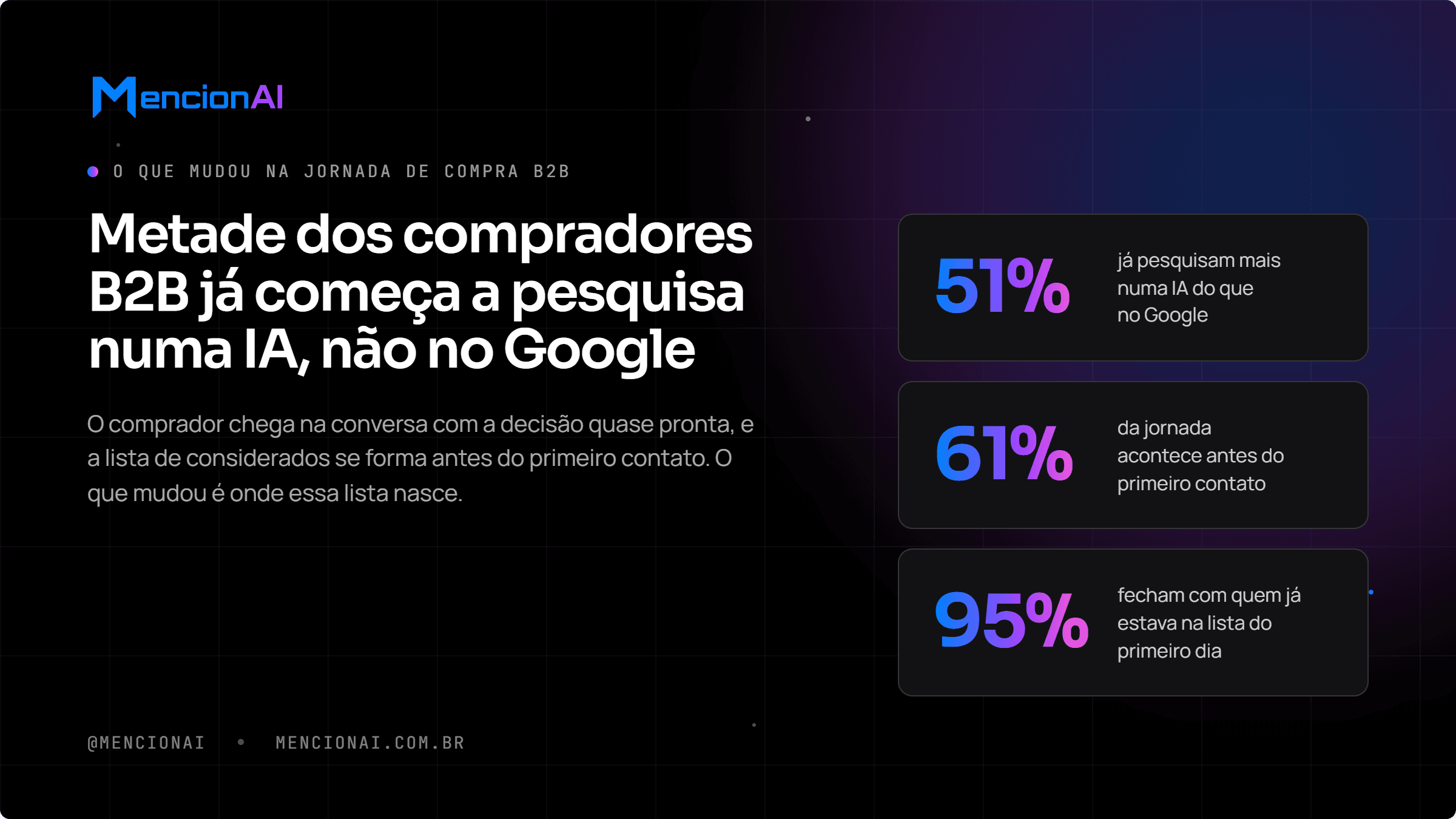
I came across a statistic from G2 this week that I decided to break down piece by piece: 51% of B2B software buyers now search more in an AI chatbot than on Google. The report is extensive and serious, the G2 2026 AI Search Insight Report, created specifically to measure this.
Quick answer
No. SEO ranks links on a results page. GEO measures whether your brand is cited inside AI answers on ChatGPT, Gemini, Claude, Perplexity, Grok, and DeepSeek.
Summary
- G2 isn’t the only one pointing this out. A survey from 6sense, the Buyer Experience Report 2025, found that 94% of B2B buyers consult some AI model at some point during their evaluation before closing a deal.
- GEO, Generative Engine Optimization, is the set of practices to increase the chances of your brand being cited when a generative model responds to someone.
- An AI model prioritizes sites with real authority, consistent mentions in forums and independent reports, structured data, and direct comparisons between solutions.
- I found it important to bring this side up as well, because only looking at the rising numbers gives the wrong impression.
- Publishing case studies and direct comparisons, in an easily indexable format, helps a lot, because it’s exactly the type of content that models prefer to cite.
- It was precisely with this in mind that we built MencionAI.
I sought more numbers to understand the scale of this change, and the picture became even clearer than I expected.
Search has changed location before changing form
G2 isn’t the only one pointing this out. A survey from 6sense, the Buyer Experience Report 2025, found that 94% of B2B buyers consult some AI model at some point during their evaluation before closing a deal. This has ceased to be the behavior of early adopters testing a novelty. It has become the standard.
And the traffic that comes from these conversations converts differently. A study by Semrush, covered by PPC Land, measured 4.4 times more conversion in visitors coming from AI search than in traditional organic traffic. Those arriving this way have already been filtered by a specific answer, not starting their research from scratch.
What is GEO, a quick summary
GEO, Generative Engine Optimization, is the set of practices to increase the chances of your brand being cited when a generative model responds to someone. Classic SEO competes for links in a list of results. GEO competes for citation within a response that the AI already provides. The criteria change accordingly: data structure, source authority, consistent mention in quality content, presence in the databases that feed these models.
A company that only optimizes for traditional SEO risks disappearing from exactly half of the buyers that G2 is describing.
How AI decides who to cite
An AI model prioritizes sites with real authority, consistent mentions in forums and independent reports, structured data, and direct comparisons between solutions. It also gives weight to updated content. Ranking well on Google doesn’t guarantee any of this. The criteria are different, and the games are different.
But pay attention to what hasn’t changed
I found it important to bring this side up as well, because only looking at the rising numbers gives the wrong impression. The same report from 6sense showed that 61% of the buying journey is already complete before the first contact with the supplier, and 95% of negotiations go to those who were already on the consideration list from day one. A study by TREW Marketing with GlobalSpec also found that 70% of buyers choose the most recognized brand when options seem similar.
The benchmark for who wins the business remains the same as always: getting to the top of the list that matters first. However, now this list also originates within a conversation with AI, before any commercial meeting takes place.
What can be done with this now
Publishing case studies and direct comparisons, in an easily indexable format, helps a lot, because it’s exactly the type of content that models prefer to cite.
Keeping your profile updated on platforms like G2, Capterra, and TrustRadius also counts, as these places frequently feed AI responses.
Seeking mentions in podcasts, newsletters, and technical communities in your sector contributes to the same goal; it’s presence that reinforces authority outside your own site.
Using structured data, like schema markup, to clarify features, pricing, and use cases makes it easier for language models to read.
And monitoring outdated or negative mentions is just as important as publishing new content, because this also factors into the response that AI builds about your brand.
Why I monitor this every day at MencionAI
It was precisely with this in mind that we built MencionAI. We monitor how and when your brand is cited in major AIs, look at what competitors are getting in those same responses, and provide a practical action plan instead of just a pretty graph.
Ignoring this migration is betting against your own numbers. Those who start monitoring now, while the volume is still growing, will be well ahead of those who only look at this when it becomes obvious to everyone.
If you want to see for yourself where your brand stands in this change, MencionAI's trial is free for 7 days. You can run diagnostics on major AIs and come away with mention coverage, share of voice against competitors, and a practical action plan.
Pedro, CMO of MencionAI
FAQ
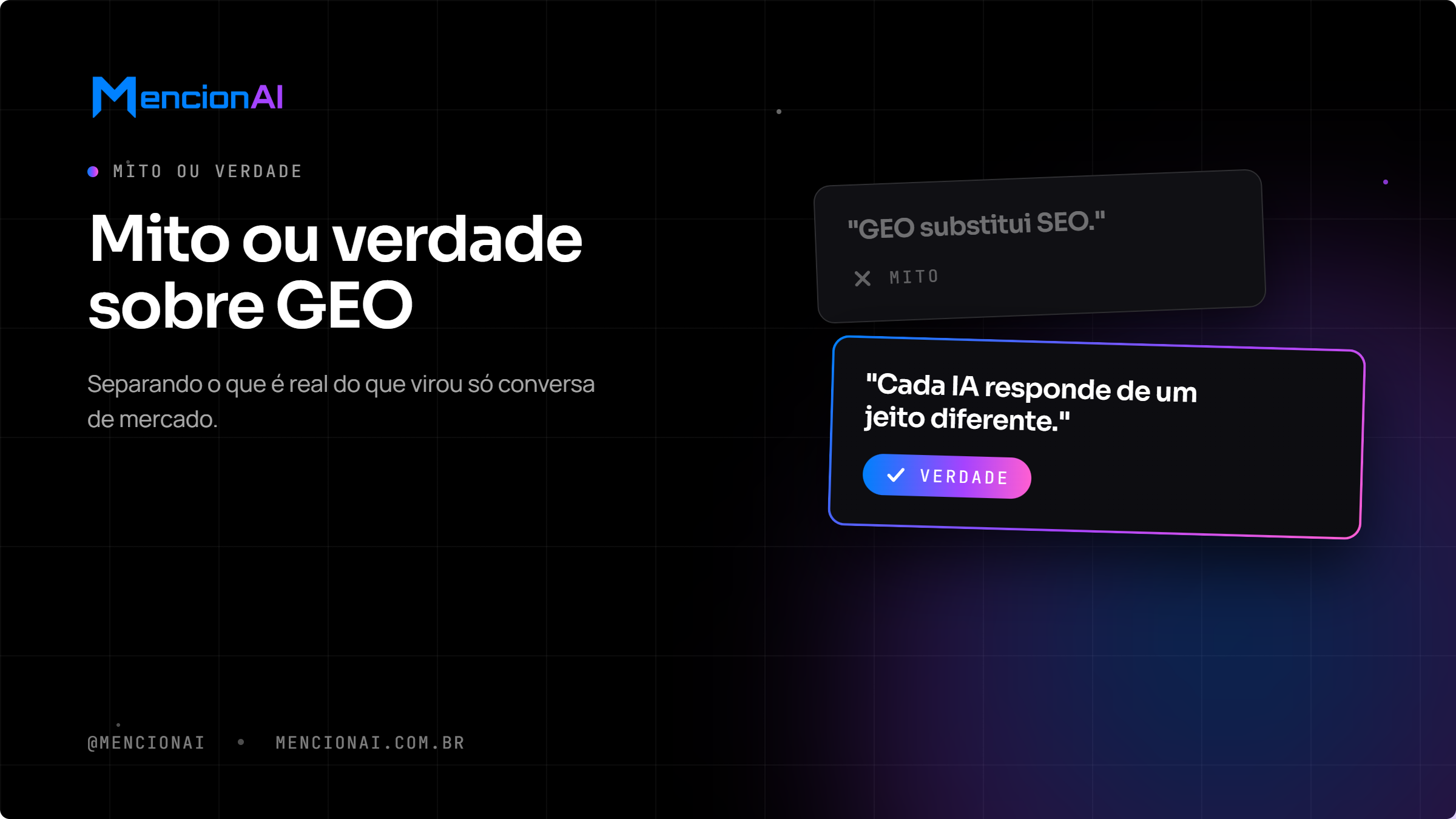
Is GEO a replacement for SEO?
No. SEO ranks links on a results page. GEO measures whether your brand is cited inside AI answers on ChatGPT, Gemini, Claude, Perplexity, Grok, and DeepSeek.
What should we publish first for AI citations?
Comparison pages, FAQ hubs with stable anchors, llms.txt, and Organization schema — then re-scan the same prompts.
What is E-E-A-T and how does it help AI citations?
Google Search Central describes E-E-A-T as experience, expertise, authoritativeness, and trustworthiness — trust first. Named authors, first-hand experience, and citations to official docs help people judge who stands behind the page. Structured data is not required for AI Overviews, but Article, Person, and Organization markup still help Search understand the author and publisher.
Sources
- Google Search Central — helpful, people-first content (E-E-A-T)
- Google Search Central — AI-generated content
- Google Search Central — generative AI features on Search
- Google AI features (AI Overviews and AI Mode)
- G2 — The Answer Economy (51% of B2B software buyers start in AI chat)
- G2 — 2026 AI Search Insight Report
- 6sense — 2025 B2B Buyer Experience Report