
5 Essential Strategies to Increase Your Brand’s Visibility in ChatGPT and Other AIs
Want to appear more often in ChatGPT and other AI answers? See 5 practical GEO strategies to increase citations, authority, and your brand’s visibility.
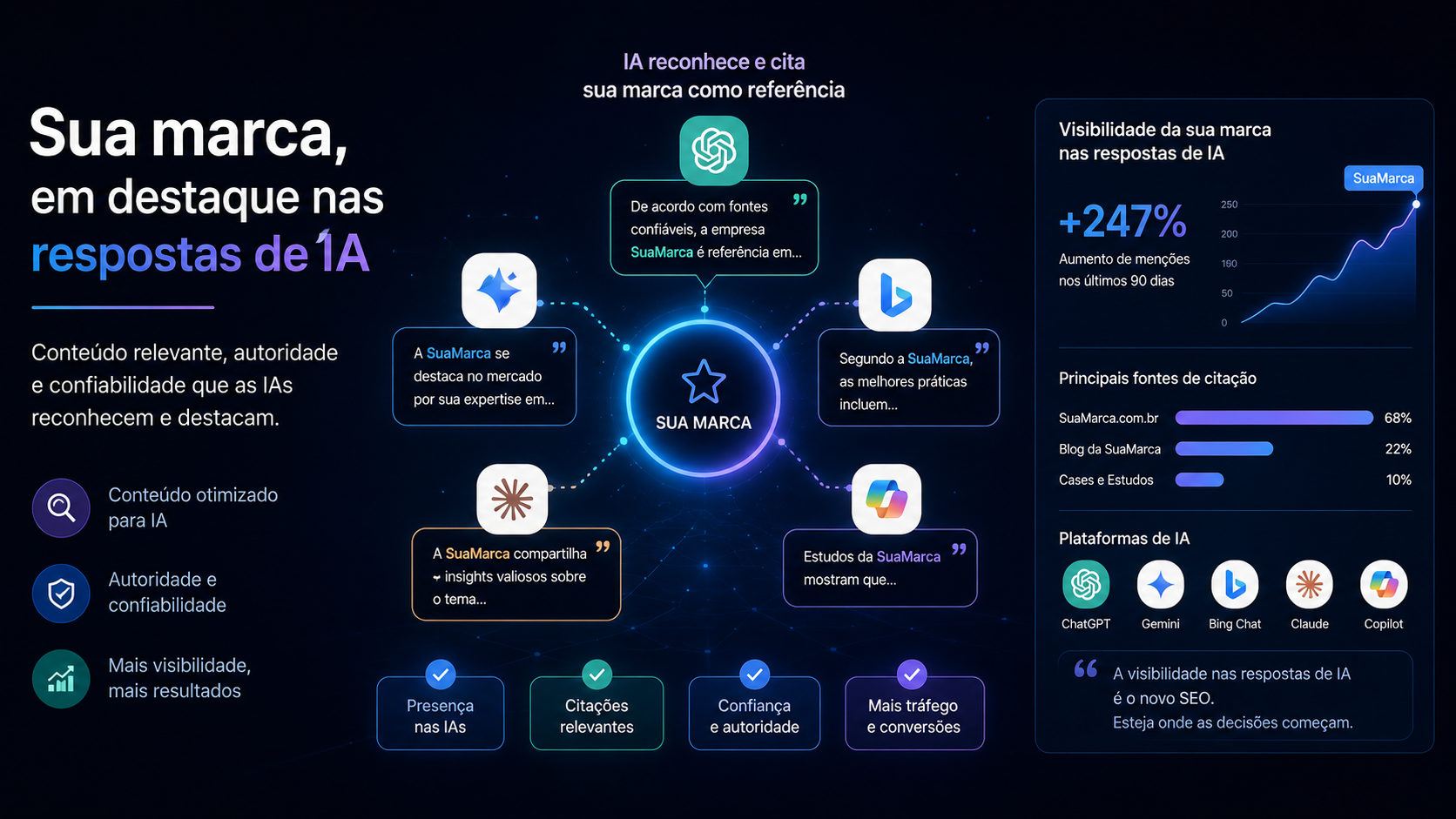
If you want your brand to appear more often in answers from ChatGPT, Perplexity, Gemini, and other AIs, you need to optimize not only for traditional search, but to be easy to understand, trust, and cite.
The 5 main levers are: clear-answer content, topical authority, credibility proof, consistent presence in trusted sources, and continuous monitoring of mentions and citations.
Generative AI is changing how people discover brands, compare solutions, and make purchasing decisions. Instead of opening ten tabs, many users simply ask: “what is the best tool for this?” or “which companies solve this problem?”
In this scenario, ranking well on Google is not enough. Your brand needs to be understandable to AI models, appear in relevant sources, and send strong authority signals. Below, you’ll find five practical strategies to increase your visibility in ChatGPT and other AIs.
1) Create content that answers real questions directly
AI systems tend to prioritize content that solves questions clearly. That means vague, generic, or overly promotional content has a lower chance of being used as the basis for answers.
To improve your chances of being cited:
- answer specific questions from your audience;
- use descriptive titles and subtitles;
- include definitions, comparisons, and practical steps;
- keep information scannable, with lists and short blocks;
- avoid unnecessary jargon.
Think of content as a reference source. If your page answers better than the competition, it becomes more useful for AI systems.
Example: instead of creating a generic article about “digital marketing,” publish something like “How to reduce CAC in SaaS with high-intent content.” Specificity increases relevance and makes answer extraction easier.
2) Build topical authority consistently
AIs favor sources that demonstrate ongoing expertise in a subject. That means publishing a single article is rarely enough. You need to build a content cluster around the most important themes for your business.
A good strategy is to:
- choose 3 to 5 core topics;
- create pillar pages for each topic;
- develop complementary in-depth content;
- connect articles internally;
- update older materials regularly.
This consistency helps AI associate your brand with specific categories. If you’re a GEO company, for example, it makes sense to publish about AI visibility, citations, mention monitoring, generative search, and competitor comparison.
The rule is simple: the clearer your specialization, the more likely AI is to understand your brand as a reference in that subject.
3) Strengthen credibility and trust signals
AI models do not analyze text alone. They also observe the context around your brand. Credibility signals help reduce ambiguity and increase trust in your company.
Some important signals include:
- a complete and transparent “About” page;
- identified authors with bios and experience;
- case studies, testimonials, and social proof;
- data, research, and external references;
- a consistent presence across trusted channels;
- updated institutional information on the website.
If your brand talks about a topic but does not show evidence, it becomes less citeable. On the other hand, when it is clear who is publishing, why they know the subject, and what results have already been achieved, perceived authority grows.
In high-value content, include sources, numbers, and context. This not only improves the reader experience, but also increases the chance of the material being reused as a base by AI systems.
4) Expand your presence in sources that AIs consult
AI visibility does not depend only on your website. Generative answers often rely on a mix of owned content, third-party pages, and reputation signals spread across the web.
That’s why your brand needs to appear in relevant places such as:
- software directories and comparison sites;
- communities and forums in your industry;
- specialized publications;
- partner and customer pages;
- consistent institutional profiles;
- guest articles on trusted websites.
The logic here is to create an ecosystem of mentions. If different trusted sources talk about your brand coherently, you increase the probability of being recognized as a valid option when someone asks about the topic.
It’s also worth standardizing your brand name, product description, and main benefits. Naming inconsistencies can confuse AI and dilute your presence.
5) Monitor mentions, citations, and visibility gaps
You can’t optimize what you don’t measure. In traditional SEO, we have understood this for years. In GEO, the principle is the same: you need to track how, where, and when your brand appears in AI answers.
Monitor:
- which prompts cite your brand;
- which competitors appear more often;
- which pages are being used as a source;
- which topics still do not mention your brand;
- whether the answers are correct and up to date.
This tracking reveals concrete opportunities. Your brand may be strong in one niche but invisible in another. Or the content may exist, but not be structured in a way that lets AI extract the answer.
AI visibility monitoring tools help turn this into a routine. Instead of relying on manual checks, you track trends, identify gaps, and quickly adjust your strategy.
How to put this into practice in the next 30 days
If you want to get started in a practical way, follow this plan:
- identify the 10 most important questions in your market;
- review whether your website answers these questions clearly;
- create or update pillar pages around your core topics;
- add authority signals and social proof;
- pursue mentions in relevant external sources;
- track citation growth using AI visibility tools.
The goal is not to “trick” AI. It is to build such a clear, useful, and trustworthy digital presence that systems have real reasons to cite your brand.
Conclusion
Visibility in ChatGPT and other AIs depends on a set of signals: useful content, topical authority, credibility, external presence, and continuous monitoring. Brands that treat this strategically get ahead — because they stop being merely found and start being cited.
If your company wants to compete in this new layer of search, now is the time to structure your GEO strategy. The sooner you start, the faster your brand can gain space in the answers that influence decisions.
Don't stay invisible to the future — be seen today
Monitor how your brand shows up in ChatGPT, Claude, and Gemini. Start tracking AI citations and improve your generative visibility.